by Isabella Grecco
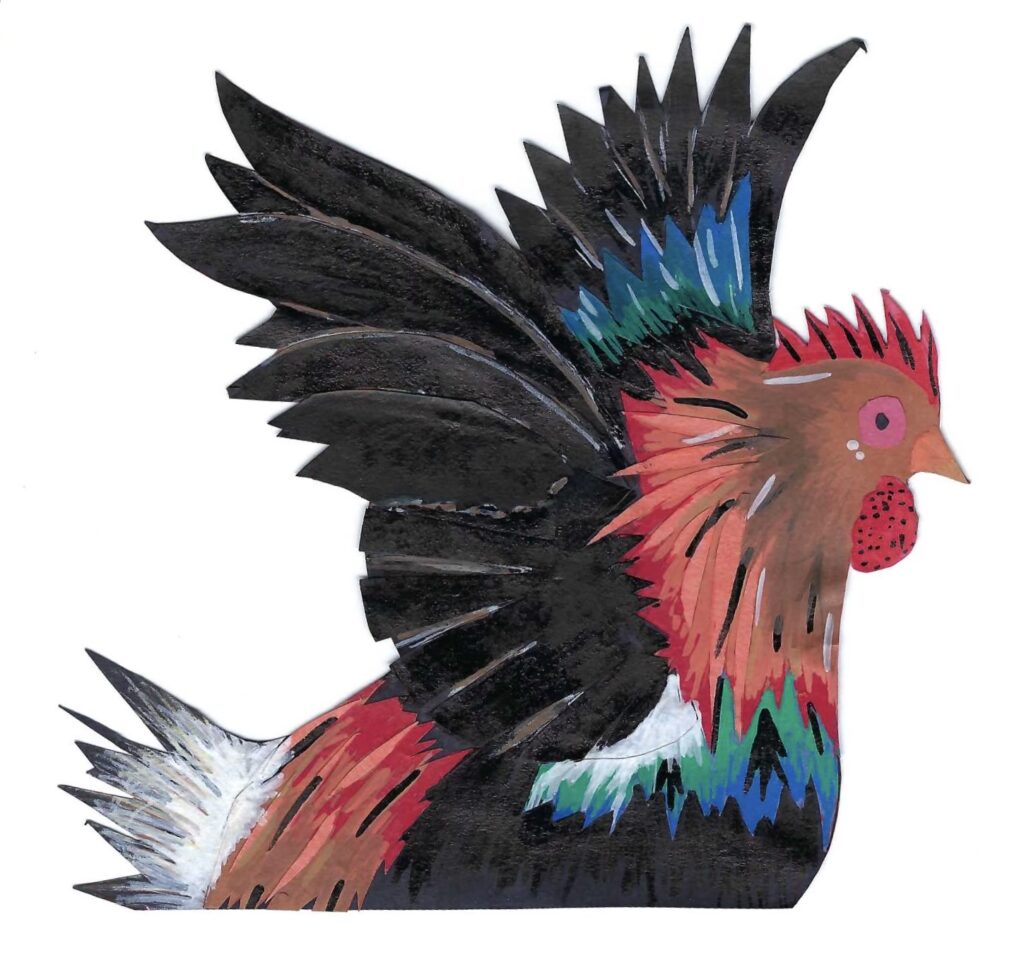
In the fall of 1992, a Category 4 hurricane hit Hawaii. It was named Hurricane Iniki, the most destructive hurricane to hit Hawaii in the 20th century and sixth costliest in US history. The island of Kauai took most of the damage, so severe that phones, power, and water weren’t restored for three to four months after Iniki. The hurricane left Kauai in economic despair, as the tourist location was destroyed leaving 75% of jobs lost on the island, with the only remaining hotel at the time being the Hilton. After $3.1 billion worth of damage to Kauai and an ongoing journey of repair, a new ‘problem’ arose (Lawson, 2018).
Chickens. Everywhere.
It turns out that Hurricane Iniki also destroyed lots of chicken coops on the island of Kauai, resulting in an overpopulation of chickens roaming free on the island, with no natural predators to aid population control.
While the bird is a sort of mascot for the island, with merch and all, some cannot stand the birds because of their constant noise and the amount of space they take up. I argue that the chickens of Kauai are not a burden, but a resilient companion that demonstrates resilience beyond humans and the co-creation of a livable world after disaster.
Using Patrice Buzzanell’s Communication Theory of Resilience (2017), which frames resilience as more than just a trait one has, but something people do together through communication, and applying it to the chickens, we can understand how the amount of sound and movement chickens make is a communicative and co-created assertion of identity. This is extended with Donna Harraway’s concept of companion species (2003), which discusses humans and nonhumans not being separate from one another but actually mutually shaping each other’s existence, in this case humans and chickens co-surviving after disaster.
Rather than seeking control over the chickens of Kauai, we should understand their presence to be grounded in a feminist, post-human model of resilience that contributes to the flourishing of the island after the devastation.
Works Cited
Buzzanell, P. (2017). Communication Theory of Resilience. In D. Braithwaite (Ed.), Engaging Theories in Family Communication: Multiple Perspectives (pp. 98–109). Routledge.
Harraway, D. (2003). The Companion Species Manifesto: Dogs, People, and Significant Otherness. Prickly Paradigm Press.
Lawson, J. (2018, April 9). Hurricane Iniki: Look at All Those Chickens. (Im)Possibilities. https://morrison.sunygeneseoenglish.org/2018/04/09/hurricane-iniki-look-at-all-those-chickens/
Isabella Grecco is a museum educator and social justice researcher based in Connecticut. She earned her Master’s degree in Social Justice Education from SUNY New Paltz, where her work focused on equity, critical pedagogy, and community-based learning. She is an enthusiastic post-qualitative researcher with a dedication exploration of how culture, education, and storytelling can be tools for anti-racist practice, among other social justice related goals!